

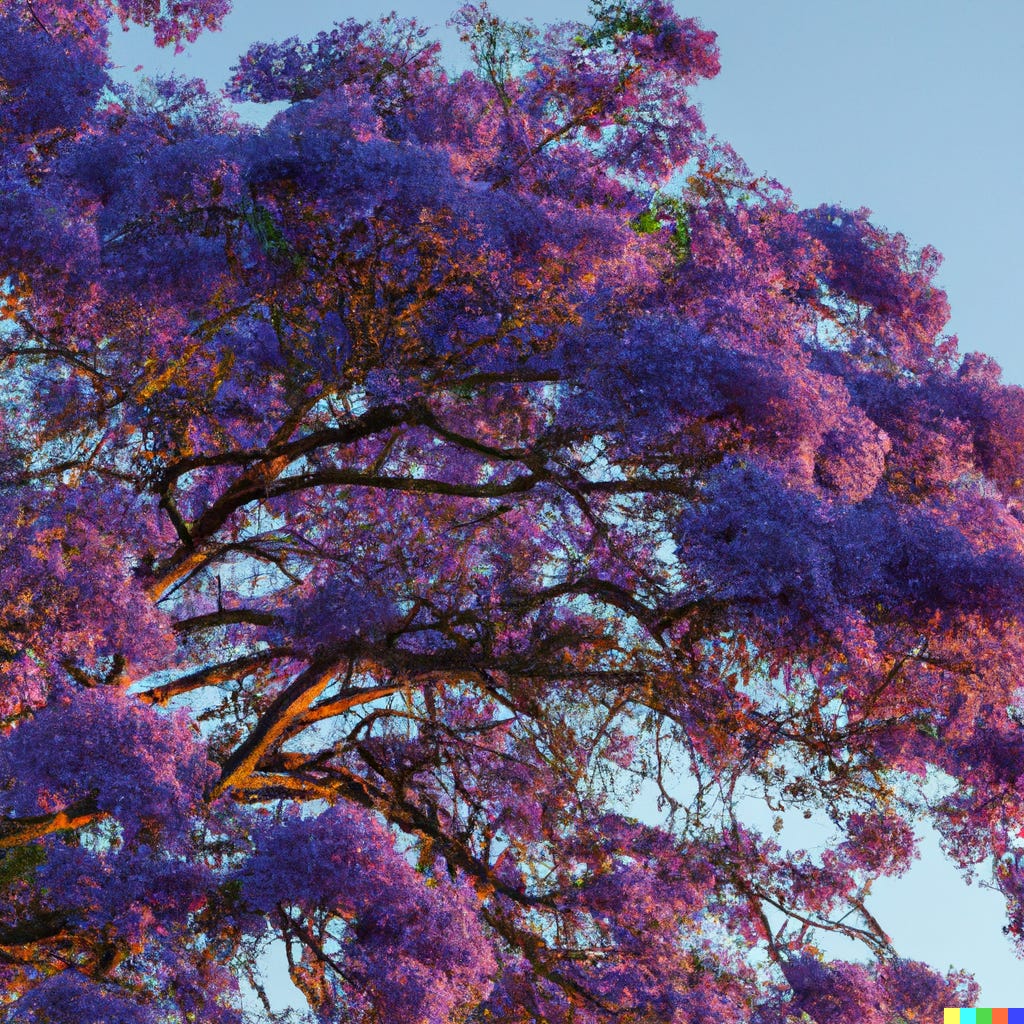
Jacaranda dawn. A gentle breeze colors Oaxaca in a magenta wash. Within hours the daytime will warm up, and the streets will grow dusty and dry. But for now, I jog through the morning cool of the city.
It’s early—not even 8 am—but the city is already alive with energy.
I maneuver between gossiping dog walkers and chatting food vendors setting up their comáls, then wind through a park where a group of dancers move to a pulsating beat. I end up in the historic Centro, the oldest part of the city, where cobblestone streets are lined with cafes and restaurants painted in the orangey-yellow of dripping mangos or the pink of crushed Fuschia flowers. Reverent, sand-colored churches peer out over the tops of buildings, their stained-glass eyelids still foggy with morning dreams. Between shops, inconspicuous alleyways give way to unexpected marketplaces where morning shoppers make their rounds, and in plant-draped courtyards, people sit drinking coffee.
Located in Southern Mexico, Oaxaca is a place of warmth. Home to a rich culinary tradition, the region boasts a culture of chocolate, coffee, and mezcal production. The valleys that surround the city are filled with villages offering a wealth of intricate artisanal craftwork—pottery, wood-carving, weaving—as well as archaeological sites featuring ancient ruins that are thousands of years old.
We drive into the hills outside the city to visit these ruins and the artisanal villages. In San Bartolo Coyotepec, we watch a demonstration of barro negro (black pottery) from the grandson of the woman who invented a famous practice of polishing dry clay pieces with quartz. With this method, after firing, the unpainted pieces appear to have a glossy black finish. In San Martín Tilcajete, an artisan teaches us how alebrijes are made, swiftly transforming a raw piece of wood into a lifelike cat. It is an Art that requires intense skill and patience—our host tells us that some pieces can take four weeks to create.
Our last stop is Teotitlán del Valle, where artisans create exquisite woven pieces from scratch. Here, yarns used in weaving are dyed by hand, with colors extracted from natural elements. At an artist’s cooperative in the village, a woman asks for my hand. From a nopal cactus leaf, she scrapes off what appears to be a white powder, but is really the body of insects—the cochineal nymphs. In a swift movement, she crushes the white powdery insects in my palm and a deep purple—like the crushed summer blackberries of my childhood—explodes across my skin. She squeezes lime juice into my palm and the acid causes the dark color to transform into a rusty orange. She gestures to a rack of yarns behind her—browns, greens, oranges, pinks, reds, and purples. They are all colored with dyes made from the Cochineal insect.
I am amazed that from such small and unassuming creatures such color can emerge.
We drive back, my palm like a splotchy painter’s palette. The last part of the drive into the city takes us through a street covered by a long leafy canopy. I marvel at the tunnel of green branches and leaves that seem to stretch indefinitely overhead. In front of us, the colorful and sandy mosaic image of Oaxaca comes into focus.
The city is abundant with fruit trees. There are guava trees near our Airbnb, and at lunch, I sit sipping posole under the cool shade of a pomegranate tree. The pomegranate directly above my head is so ripe that its skin has split, and from beneath the faded pink shell, a crescent scar where the skin is torn reveals a wealth of deeply-colored pomegranate seeds. For a moment, I fear the overripe pomegranate will fall on me—but then, I am ecstatic at the thought of pomegranate seeds raining from the sky, like the Cochineal exploding.
At home too, there are fruit trees everywhere—a persimmon tree in the yard of my friend’s house, and lemons that grow just outside my building—but it is rare that I notice them.
After lunch, we take a walk through the Centro.
Before visiting Oaxaca, I had read a journal neurologist Oliver Sacks kept during his travels throughout the city in which he wrote:
“this culture is… so completely sun-oriented, sky-oriented, wind- and weather-oriented…the buildings face outward, life faces outward.”
It’s true, everything here does face outward, and for the better. I observe an instant and genuine friendliness in greetings between strangers. As Sacks says, this openness is felt not only in the people but in the surrounding architecture. Even the libraries are open-air, with silent reading rooms overlooking public reading patios.
It’s a contrast from at home, where I sometimes feel a perpetual closedness. I don’t know who my neighbors are, and often when I pass people I know on the street, we walk by as if we are strangers. The window of my dorm room overlooks another arm of my building, and the door to my bedroom opens up into a windowless living room. Campus, though safe and beautiful, is contained. Sometimes, I feel trapped.
We continue our walk. As promised, the day has grown hot. It's the dry season and I feel the water fall out of my body. My head starts to throb with desiccated thoughts and soon, there is nothing else I can do but sit. I find my way into a rooftop café where leafy plants suspend through golden space. A mango mocktail sans the mezcal provides temporary respite. I open up to the middle of Mayflies, the Scottish novel I’m currently reading. A few pages in, the main character Jimmy is on a train, where he rests his “head against the window and dream[s] for a hundred miles in black and white.”
I am struck by this line. There is something so melancholic about dreaming in black-and-white—that in the imagined realm of one’s mind, one should be constricted to the colorless.
Most nights, I don’t even remember my dreams, let alone their colors.
The next day, we take a cooking class. On the menu is a jicama ceviche, mole rojo with shrimp and white beans, and coconut tamales filled with Oaxacan chocolate. This process is also an Art—and accordingly, it is painstakingly slow, lasting the length of a day. For the mole, each side of each chili is grilled on the comál one by one by one and I find myself growing impatient. But in the slowness, relationships become less transactional, less temporary. I learn the stories of the other cooking class students, where they have come from and where they are going next, their political beliefs, and their family recipes. Finally, the food is done and it comes out perfect—the flavors are rich but not too heavy, both dynamic and delicate.
In the afterglow of our meal, as I sit sedated with chocolate tamales and pleasure, my thoughts return to Jimmy and his dreams. My fear is not like Jimmy’s, of dreaming in black and white, but of living in it. I think that color gets lost with speed, that the pace of one’s life and the hues which shade it are inextricably linked. To go fast is to let the colors of life blur together so that once-varied shades grow smudged together in an indistinguishable haze.
I realize that for the past few months at home, I have been going too fast, letting the colors drip away. I allowed myself to believe that the only way to live was to fill my days with so much busyness that even my own thoughts were crowded out. But here, removed from my routine, I am able to let go of this mindset. I slide off the familiar axes and into a realm of life that is slower and more saturated with life.
I hear the clang of ceramic dishes as someone starts to clear the table. The cooking class is over and I have the sudden awareness that my realization is fleeting. Just as sunlight decomposes color, time decomposes perspective. I’m afraid that when I go home, the colors I’m experiencing in Oaxaca will start to fade, that I’ll slowly return to black and white. But it doesn’t have to be that way. While the Oaxacan way of life has ignited a revitalized sense of fullness and warmth within me, there is a similarly abundant beauty and wonder to be found at home—it’s just that I too often fail to notice it.
I don’t want to continue on like that. Instead, I want my life to be full of color. If I think of my life as a painting, I want it to be colored by days and decisions as sharply pigmented as the walls of Oaxaca, as vibrant as the Cochineal dyes and raining pomegranate seeds. And I want this painting to be created with patience, for life can’t be rushed. I want the canvas to be decorated with brushstrokes that are administered as slowly as the individual chilis are roasted and as patiently as the alebrijes are carved from wood. This painting, then, is an abstract one. I can’t tell you what image this will amount to, only that it will be “totally free of the dependence on the figure…which, like music, illustrates nothing, tells no story, and launches no myth...where dream becomes thought, where line becomes existence” (Michael Zeuphor in Agua Viva).
Someday, I hope to take a step back from the canvas and find myself amazed that from one life such color has emerged.
In the evening—Zócalo, the public square, at 9 pm on a Saturday. A young boy dips an imaginary rod into the pond as he pretends to fish, a red-haired woman in a majestic emerald gown treads hesitantly across the plaza, a stray golden dog is drowned in sleep beside a pot of wilted pink geraniums, a girl sits cross-legged on the dusty ground on FaceTime, her laughter endless, and a small group of young children has created a makeshift jungle gym out of the locked up silvery tables and chairs of a restaurant that has closed for the night.
It’s not all laughter, though. A four-year-old girl sells handmade drawings on the sidewalk. Many of the streets I have strolled through on this trip, with their flashy storefronts and rooftop pools, have been curated to a tourist’s eye. They say that the dyes made from Cochineal can be made cheaper and faster when done synthetically.
Tomorrow, I return home. I will get stuck on a layover for an anxious night alone in Mexico City, and then I’ll be back: to a place where the fruit trees are replete but I don’t notice often them, where I cook flavorless dinners too fast, where I don’t know my neighbors, where some days, when I’m asked what I’ve done that day, I have to think for a long time before I can answer—and even then, I don’t always remember.
Or maybe, by writing this, I’ll remember the Cochineal and all its colors.
The night has come and it’s cool again. The jacaranda trees look different against the night sky—the quality of their color is transfigured against the darkness.
I always found South American poets so evocative visually. I've always wondered why that is. I've always felt very close to the Mayans. I could almost feel all of that in this piece.
Your writing, as always, is absolutely breathtaking. Some of my favorite highlights I'll be saving:
"Reverent, sand-colored churches peer out over the tops of buildings, their stained-glass eyelids still foggy with morning dreams."
"Instead, I want my life to be full of color. If I think of my life as a painting, I want it to be colored by days and decisions as sharply pigmented as the walls of Oaxaca, as vibrant as the Cochineal dyes and raining pomegranate seeds. And I want this painting to be created with patience, for life can’t be rushed. I want the canvas to be decorated with brushstrokes that are administered as slowly as the individual chilis are roasted and as patiently as the alebrijes are carved from wood."
-> not only is this absolutely beautiful, I completely agree with the sentiment. Cheers to us living our lives with more color and texture 🎉